Single-Phase vs. Two-Phase Liquid Immersion Cooling:Which is Better
Catalog
1. Immersion cooling causes
2. What is Two-Phase Liquid Immersion Cooling
3. What is Single-Phase Liquid Immersion Cooling
4. Working principle of Two-Phase
5. Working principle of Single-Phase
6. Trends and Industry Analysis
7. Reasons to Use Liquid Cooling vs Air Cooling in Your Gaming PC
Introduction:
Cooling is a critical aspect of any electronic system, especially when it comes to high-performance applications such as data centers and gaming PCs. Traditional air cooling methods have their limitations, leading to the emergence of liquid immersion cooling solutions. Within the realm of liquid immersion cooling, there are two primary approaches: single-phase and two-phase. In this article, we will explore the differences between these two cooling methods and discuss their respective advantages.
1. Immersion Cooling Causes:
Before diving into the specifics of the two cooling methods, let's briefly discuss the reasons why immersion cooling has gained popularity. Immersion cooling offers superior cooling efficiency compared to air cooling, as liquids have higher thermal conductivity. It also allows for more compact designs, reduces noise levels, and enables higher overclocking capabilities.
2. What is Two-Phase Liquid Immersion Cooling:
Two-phase liquid immersion cooling involves immersing electronic components directly into a dielectric liquid, such as mineral oil. In this method, the liquid absorbs heat from the components, which causes it to vaporize. The vapor then rises to a condenser, where it is cooled and converted back into a liquid state before being recirculated.
3. What is Single-Phase Liquid Immersion Cooling:
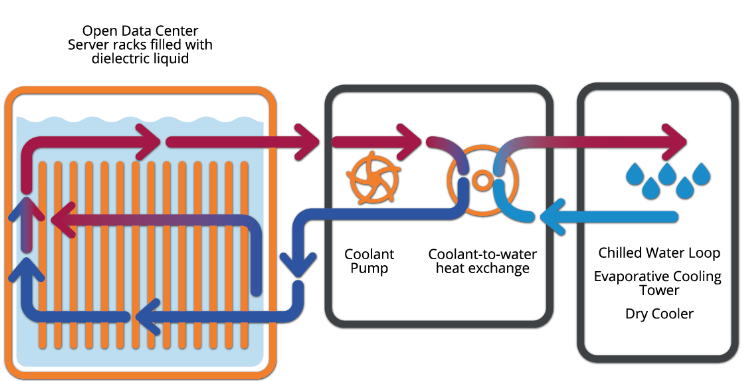
Single-phase liquid immersion cooling, on the other hand, utilizes a dielectric liquid that remains in a liquid state throughout the cooling process. The liquid comes into direct contact with the electronic components, absorbing heat and carrying it away through convection.
4. Working Principle of Two-Phase Liquid Immersion Cooling:
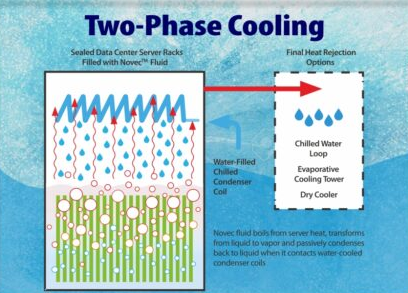
In two-phase liquid immersion cooling, the heat generated by the components causes the dielectric liquid to vaporize. This phase change absorbs a significant amount of heat, making it an efficient cooling method. The vaporization process requires additional infrastructure, such as a condenser, to convert the vapor back into a liquid state for recirculation.
5. Working Principle of Single-Phase Liquid Immersion Cooling:
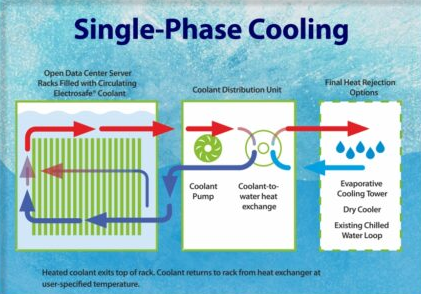
In single-phase liquid immersion cooling, the dielectric liquid remains in a liquid state throughout the cooling process. It directly absorbs heat from the components and carries it away through natural convection or forced circulation. This method typically requires less complex infrastructure compared to two-phase cooling.
Single-Phase Liquid Immersion Cooling
| Two- Phase Liquid Immersion Cooling
| |
Phase of the Liquid | The coolant stays in liquid state and does not evaporate
| The coolant exists in 2 states. The liquid undergoes a change in phase and becomes gas
|
Coolant
| Hydrocarbon-based dielectric fluid that's similar to mineral oil
| Fluorocarbon-based engineers liquid with a very low boiling point
|
Coolant Cooling
| Circulated through a heat exchanger to transfer the heat to water lo0p, which in-turn is cooled by evaporative cooling, dry tower or chiller plant
| The vapor is then condensed back to the liquid form via water-cooled condenser coils, which are integrated into the top of the sealed racks
|
Coolant Price
| Pocket friendly to buy and to maintain. The same fluid runs for 15 years or above
| Order of magnitude more expensive than GRC's single- phase cooling. The coolant must be replenished at hundreds of dollars per gallon
|
Coolant Safety
| The synthetic hydrocarbon- based fluids, like GRC'S ElectroSaferm, are clear, odorless, non-toxic, and widely used in domestic products such as cosmetics
| Fluorocarbon-based coolants often have extremely high GWP (Global Warming Potential) and prolonged exposure to the vapor can cause health and environmental concerns
|
User and Pocket Friendliness
| Simple and easy mechanism which is easy on the pocket to buy and to maintain
| More complicated with higher up front costs, and higher coolant prices while replenishment
|
Rack Density
| Can support a rack density of 200kW, which is enough for next-gen technologies like Al, loT, 5G etc.
|
Can support extreme rack density of up to 250 kW per rack |
Rack Design
| The rack design can be open or closed. There is never a risk of losing coolant
| Does not allow for open rack The temperature of the coolant fluctuates between evaporation to cooling, taking the equipment temperature through a wide range
|
Temperature Extremes
| The coolant maintains the equipment in a comfortable range of temperature with no extreme fluctuations
| The temperature of the coolant fluctuates between evaporation to cooling, taking the equipment temperature through a wide range |
6. Trends and Industry Analysis:
Both single-phase and two-phase liquid immersion cooling have gained traction in various industries. Two-phase cooling is often preferred for applications with extremely high heat loads and where precise temperature control is crucial. Single-phase cooling, on the other hand, offers simplicity, lower infrastructure requirements, and ease of maintenance, making it suitable for a broader range of applications.
7. Reasons to Use Liquid Cooling vs Air Cooling in Your Gaming PC:
Liquid cooling, whether it be single-phase or two-phase immersion cooling, offers several advantages over traditional air cooling in gaming PCs. These include improved thermal performance, quieter operation, better overclocking potential, and reduced risk of component damage due to overheating. However, it's important to note that liquid cooling systems require proper installation and maintenance to ensure optimal performance and prevent any potential leaks.
Conclusion:
When it comes to liquid immersion cooling, both single-phase and two-phase methods have their merits. The choice between them depends on the specific requirements of the application, including heat load, temperature control needs, and infrastructure constraints. As the demand for advanced cooling solutions continues to grow, both methods are likely to find their place in different industries, offering improved thermal management for high-performance electronic systems.


Related Articles

Capacitor Basics: Definition, Characteristics, and Applications
What is Electronic Ballast: Pros & Cons
Exploring the Versatility and Performance of Cat 7 Cable
Microcontroller: Revolutionizing Embedded Systems
Understanding GSM Modules: Component for Wireless Communication
3D Printing Electronics: Revolutionizing the Future
14 Electronic Components in an iPad
Popularization of Electronic Amplifiers: Working principles
Understanding Pinout: A Comprehensive Guide
A Beginner's Instruction Manual about Raspberry Pi
Power Transformers vs Converters: Are they the same
Circuit For Buck Boost Converters: Stable Transforming Voltage