Pull-Up & Pull-Down Resistors Difference, Pros & Cons, Selection
Hi, friends, Understanding Pull-Up & Pull-Down Resistors: Differences, Pros & Cons, and How to Select the Right One
In the intricate world of electronic circuits, the choice of resistors can make or break the functionality and efficiency of a system. Among the various types, pull-up and pull-down resistors are fundamental components frequently employed for their ability to ensure predictable logic levels. This article delves into the nuances distinguishing pull-up from pull-down resistors, evaluates their advantages and disadvantages, and provides a practical selection guide for electronics enthusiasts and engineers alike.
Pull-Up Resistors
![]N}ZUBE(P~(LIP@SMEBK1HE](https://www.chip-ic.com/upload/image/content/20240316/952861c0f5dae48ef86e6766cc6ccce5.png "952861c0f5dae48ef86e6766cc6ccce5.png")
Definition
Pull-up resistors are resistive components connected between the voltage supply (often denoted as Vcc) and a given signal line. Their primary function is to ensure that a signal assumes a high logic level in the absence of an active input.
How They Work
In their idle state, pull-up resistors pull the voltage of the signal line up to the supply level, typically representing a logical '1'. When an active low (ground) signal is applied, the pull-up resistor allows the voltage to drop, registering a logical '0'.
Pros
- Prevents floating lines which can lead to unpredictable circuit behavior.
- Ensures a default high state, beneficial for active-low configurations like button inputs.
- Simple to implement in both breadboard prototypes and integrated designs.
Cons
- Constantly draws current when the line is driven low, which can be a drawback for power-sensitive applications.
- Incorrect selection of resistor values can lead to slow signal rise times, impacting the performance of high-speed circuits.
Pull-Down Resistors

Definition
Conversely, pull-down resistors are connected between a signal line and ground. They serve to keep the signal at a low logic level when no other input is present.
How They Work
Pull-down resistors ensure that in their default state, the signal lines are pulled down to ground, representing a logical '0'. When a high signal is applied, the logical level shifts to '1', overriding the pull-down resistor.
Pros
- Provides a clear low state in the absence of inputs, which is essential for active-high configurations.
- Helps to avoid floating lines, maintaining reliable circuit operation.
Cons
- Like pull-up resistors, they draw current when the signal is driven high, which may not be ideal for battery-operated devices.
- Selecting an improper resistor value can cause slow fall times and potentially hinder circuit response speed.
Difference Between Pull-Up and Pull-Down Resistors
While both types of resistors serve to provide a default state for signal lines, their application depends on the desired default logic level. Pull-up resistors are typically used when the idle state is high, while pull-down resistors are used when the idle state is low.
Electrical Characteristics
The pull-up resistor must be able to supply enough current to any input connected to the signal line without creating a voltage drop below the high-level input voltage. Similarly, a pull-down resistor must ensure that the voltage does not rise above the low-level input voltage when a low state is expected.
Typical Applications
- **Pull-Up Resistors:** Often found in I2C bus connections, microcontroller input pins, and switch circuits.
- **Pull-Down Resistors:** Commonly used in push-button interfaces, reset lines, and digital logic circuits.
Pros and Cons Comparison
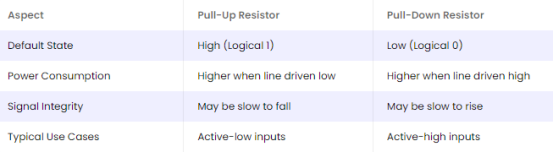
The choice between pull-up and pull-down configurations depends on various factors such as power consumption, signal integrity, and the intended resting state of the signal line.
Selection Guide
Factors to Consider
When selecting a pull-up or pull-down resistor, consider the input impedance of the device being driven, the voltage levels, and the current draw. The goal is to choose a resistor value that minimizes unnecessary power consumption while ensuring fast enough transition times for the signal.
Tips for Choosing the Right Resistor
- For I2C bus applications, standard pull-up values range from 1.5kΩ to 10kΩ.
- For microcontroller inputs, 10kΩ is a commonly used value, balancing power consumption with performance.
- In high-speed or low-power applications, resistor value selection becomes more critical and may require careful calculation or empirical testing.
Conclusion
Both pull-up and pull-down resistors play pivotal roles in digital electronics by providing stability and predictable logic levels. Understanding their differences, benefits, and limitations is crucial for any circuit designer. By carefully selecting these components according to the guidelines provided, you can ensure robust and reliable electronic designs.
We invite you to deepen your understanding by engaging with further resources or reaching out to the community for discussions. Whether you're a seasoned engineer or a budding hobbyist, mastering the subtle art of resistor selection is a step toward more effective and efficient electronic designs.


Related Articles

What are Sensors: Types, Application, Working
The Role of Electronics in the Charger: A Comprehensive Guide
How Knock Sensors Work: Price, Diagram, How to Test
CPLD vs FPGA: Architechture, Price and Application
Coaxial Cable vs. Monitor Cable: A Comparison
How Effective is Thermoelectric Cooler
On GaN: Application, Advantages & Disvantages
Electronic Components in Mobile Phones and the Chip Shortage Impact
How Many Chips Does a Car Need
HDMI vs DVI vs DisplayPort vs VGA: Comparing Pros & Cons
On Shunt: Definition, Use and Types of Shunts
On Video Websites Recommendation Systems