Popularization of Electronic Amplifiers: Working principles
Revealing the Working Principle, Application, Advantages, of Electronic Ballasts with our detailed information to dispel your doubts(FAQ).
Catalog
What are Amplifiers
Key Features and Advantages
What is a Current Amplifier
What is a Power Amplifier
Amplifier Gain
What are Amplifiers:
Amplifiers play a crucial role in enhancing the audio experience, whether it's in a professional setting or for personal enjoyment. They are devices that increase the amplitude of an electrical signal, resulting in a more powerful sound. In this blog post, we will explore the features and advantages of amplifiers, shedding light on why they are essential components of any audio setup.
A circuit that boosts the strength of an input signal is referred to as an amplifier in general. Amplification devices' circuit designs and techniques of operation might differ, nevertheless. Small signal amplifiers are frequently employed in the area of electronics because they may boost a relatively weak input signal, such as that from a sensor, to a stronger output signal that can power things like relays, lamps, or loudspeakers.
Operational amplifiers, small signal amplifiers, large signal amplifiers, and power amplifiers are only a few examples of the several types of amplifiers. The classification of an amplifier is determined by a number of elements, including the size of the signal it amplifies (small or large), the amplifier's physical design, and how the input signal is processed, particularly the relationship between the input signal and the load's current.
Enhanced Audio Quality and Volume Control
One of the primary benefits of using an amplifier is the improvement in audio quality. Amplifiers are designed to accurately reproduce sounds across different frequencies, ensuring that every detail of the audio is heard. They have the ability to enhance both low and high-frequency sounds, providing a well-balanced and dynamic audio experience. Additionally, amplifiers allow for precise volume control, enabling users to adjust the sound output to their desired level without distortion.
Increased Power and Efficiency
Amplifiers are known for their ability to boost the power of audio signals. By amplifying the signal, they deliver more power to the speakers, resulting in a louder and more immersive sound experience. This is particularly beneficial in large venues or outdoor events where the sound needs to reach a larger audience. Furthermore, amplifiers are designed to operate efficiently, minimizing power consumption while maximizing output power. This means that they can provide a significant boost in audio performance without straining the electrical system.
Compatibility and Flexibility
Amplifiers are highly versatile devices that can be used with a wide range of audio equipment. Whether you have a home theater system, a musical instrument, or a professional audio setup, amplifiers can easily integrate into your existing setup. They come in various types and configurations, such as stereo amplifiers, mono amplifiers, and multi-channel amplifiers, allowing users to choose the one that best suits their needs. Moreover, amplifiers often have multiple input and output options, making them compatible with different audio sources and speaker configurations.
**Working Principles:**
- Amplifiers work based on the principle of using active electronic components, such as transistors or operational amplifiers, to increase the amplitude of a signal.
- The input signal is usually applied to the amplifier circuit, which processes and amplifies it, resulting in an output signal with a higher magnitude.
**Applications:**
- Amplifiers find applications in various fields, including audio systems, telecommunications, medical equipment, industrial control systems, and scientific instruments.
- They are used in audio amplification for amplifying sound signals from sources such as microphones, musical instruments, or audio playback devices.
- Amplifiers are used in communication systems to strengthen weak signals for transmission or reception.
- They are essential in instrumentation and measurement systems for accurate signal processing.
What is a Voltage Amplifier
- A voltage amplifier is an amplifier circuit designed to amplify the voltage of an input signal while maintaining the same current.
- It provides a higher output voltage than the input voltage, making it suitable for applications where voltage amplification is required, such as audio amplification.
What is a Current Amplifier
- A current amplifier is an amplifier circuit designed to amplify the current of an input signal while maintaining the same voltage.
- It provides a higher output current than the input current, making it suitable for applications where current amplification is required, such as in sensor interfaces or transducer circuits.
What is a Power Amplifier
- A power amplifier is an amplifier circuit designed to deliver high-power output signals to drive loads such as speakers, motors, or antennas.
- It is capable of amplifying both voltage and current to provide high-power amplification, making it suitable for applications where high-power output is required, such as audio systems or RF (radio frequency) amplification.
Amplifier Gain
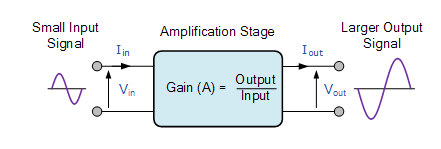
The introduction to the amplifier gain can be said to be the relationship that exists between the signal measured at the output with the signal measured at the input. There are three different kinds of amplifier gain which can be measured and these are: Voltage Gain ( Av ), Current Gain ( Ai ) and Power Gain ( Ap ) depending upon the quantity being measured with examples of these different types of gains are given below.
Amplifier Gain of the Input Signal
Voltage Amplifier Gain

Current Amplifier Gain

Power Amplifier Gain

Note that for the Power Gain you can also divide the power obtained at the output with the power obtained at the input. Also when calculating the gain of an amplifier, the subscripts v, i and p are used to denote the type of signal gain being used.
The power gain (Ap) or power level of the amplifier can also be expressed in Decibels, (dB). The Bel (B) is a logarithmic unit (base 10) of measurement that has no units. Since the Bel is too large a unit of measure, it is prefixed with deci making it Decibels instead with one decibel being one tenth (1/10th) of a Bel. To calculate the gain of the amplifier in Decibels or dB, we can use the following expressions.
· Voltage Gain in dB: av = 20*log(Av)
· Current Gain in dB: ai = 20*log(Ai)
· Power Gain in dB: ap = 10*log(Ap)
Note that the DC power gain of an amplifier is equal to ten times the common log of the output to input ratio, where as voltage and current gains are 20 times the common log of the ratio. Note however, that 20dB is not twice as much power as 10dB because of the log scale.
Also, a positive value of dB represents a Gain and a negative value of dB represents a Loss within the amplifier. For example, an amplifier gain of +3dB indicates that the amplifiers output signal has “doubled”, (x2) while an amplifier gain of -3dB indicates that the signal has “halved”, (x0.5) or in other words a loss.
The -3dB point of an amplifier is called the half-power point which is -3dB down from maximum, taking 0dB as the maximum output value.
Amplifier classes
Depending on their characteristics and circuit topologies, audio power amplifiers can operate in a variety of ways, which are referred to as amplifier classes. Each of these classes demonstrates unique features in terms of efficiency and signal reproduction, and they are identified by letters like A, B, AB, and C, among others.
1. Class A Amplifier: Class A amplifiers have low efficiency, typically below 40%. They provide good signal reproduction and linearity. In a Class A amplifier, the amplifying device conducts current continuously, even when there is no input signal. This continuous conduction helps in achieving good signal fidelity but results in higher power dissipation and lower efficiency.
2. Class B Amplifier: Class B amplifiers are more efficient than Class A amplifiers, with a maximum theoretical efficiency of about 70%. They utilize a push-pull configuration where two complementary amplifying devices (transistors or tubes) work alternately to handle opposite halves of the input signal. Each device conducts current only during one half of the input signal cycle, reducing power dissipation and increasing efficiency. However, there can be some distortion at the crossover point when switching between the two devices.
3. Class AB Amplifier: Class AB amplifiers combine elements of both Class A and Class B amplifiers. They have an efficiency rating between that of Class A and Class B amplifiers. Class AB amplifiers use a biased input stage to keep a small amount of current flowing through the amplifying device, even when there is no input signal. This biasing reduces crossover distortion and improves linearity compared to Class B amplifiers.
4. Class C Amplifier: Class C amplifiers are the most efficient among the amplifier classes but sacrifice signal reproduction and fidelity. They are typically used in applications where high efficiency is crucial, such as radio frequency (RF) power amplification. Class C amplifiers conduct current for less than half of the input signal cycle, resulting in high distortion and output waveform that bears little resemblance to the input signal. They are employed when signal fidelity is not a primary concern.
It's important to note that the choice of amplifier class depends on the specific requirements of the application. Each class has its own advantages and disadvantages, and the selection is based on factors such as power efficiency, signal quality, distortion tolerance, and cost.
Conclusion
Amplifiers are essential components for anyone seeking to enhance their audio experience. With their ability to improve audio quality, increase power, and provide compatibility with various audio equipment, amplifiers offer numerous advantages. Whether you are a music enthusiast, a professional audio engineer, or simply someone who appreciates high-quality sound, investing in a good amplifier is a decision that will undoubtedly enhance your audio setup.


Frequently Asked Questions
Related Articles

Capacitor Basics: Definition, Characteristics, and Applications
What is Electronic Ballast: Pros & Cons
Exploring the Versatility and Performance of Cat 7 Cable
Microcontroller: Revolutionizing Embedded Systems
Understanding GSM Modules: Component for Wireless Communication
3D Printing Electronics: Revolutionizing the Future
14 Electronic Components in an iPad
Popularization of Electronic Amplifiers: Working principles
Understanding Pinout: A Comprehensive Guide
A Beginner's Instruction Manual about Raspberry Pi
Power Transformers vs Converters: Are they the same
Circuit For Buck Boost Converters: Stable Transforming Voltage