A Beginner's Instruction Manual about Raspberry Pi
Hi, new friends and old friends. Welcome to the new post today.Today we will explore the best uses and projects
for the Raspberry Pi!Some of you may already know about it, but some of you don't know much about it yet.
What exactly is it? This article covers the following topics:
I.Introduction;
II.Core Components;
III.Capabilities and Applications
IV.Models of the Raspberry Pi
V.Instructions for using the Raspberry Pi
VI.Conclusion
Ⅰ. Introduction
The Raspberry Pi is a single-board computer (SBC) that is little, inexpensive, and adaptable that was created by the
Raspberry Pi Foundation. Its main objective was to advance computer science education and offer an approachable
setting for research, experimentation, and artistic endeavors. Few products have inspired the creativity and ingenuity
of amateurs and professionals alike quite like the Raspberry Pi in the field of embedded computing. The Raspberry
Pi was created with the intention of encouraging programming and tinkering, but it has now grown into a flexible
platform with uses that range from simple DIY projects to sophisticated industrial solutions. In this technical blog,
we'll examine the fundamental parts, functions, potential uses, and models of the Raspberry Pi as well as provide
a quick tutorial on how to utilize it.
Ⅱ. Core Components
A single printed circuit board houses numerous components that make up a
Raspberry Pi. Together, these parts offer computational power, networking,
and adaptability. The following are the main elements present on a typical
Raspberry Pi board:
1) Central Processing Unit (CPU)
The CPU is the brain of the Raspberry Pi, responsible for executing instructions
and performing calculations. The CPU
architecture can vary depending on the model, ranging from ARM Cortex-A53
to Cortex-A72 cores in more recent models.
2) Memory (RAM)
RAM (Random Access Memory) provides the working memory for the Raspberry
Pi. It temporarily stores data that the CPU needs to access quickly. RAM capacity
varies among different Raspberry Pi models, ranging from 1GB to 8GB in more
recent models.
3) GPIO (General Purpose Input/Output) Pins
GPIO pins are essential for interfacing with external components like sensors, LEDs,
buttons, and more. These pins allow the Raspberry Pi to send and receive digital
and analog signals, enabling interaction with the physical world.
4) USB Ports
USB ports allow the connection of various peripherals like keyboards, mice, USB
storage devices, cameras, and more. The number of USB ports can vary depending
on the Raspberry Pi model.
5) Ethernet Port
Some models of Raspberry Pi come with an Ethernet port, enabling a wired network
connection for internet access or local networking.
6) Wi-Fi and Bluetooth
Many modern Raspberry Pi models are equipped with built-in Wi-Fi and Bluetooth
capabilities. Wi-Fi provides wireless network connectivity, while Bluetooth allows
communication with devices like wireless keyboards, speakers, and more.
7) HDMI Port
The HDMI (High-Definition Multimedia Interface) port allows the Raspberry Pi to
connect to monitors, TVs, and displays, providing video and audio output.
8) Audio Jack
The audio jack lets you connect headphones or external speakers for audio output.
9) Micro SD Card Slot
The micro SD card slot is used for storage, housing the operating system, applications,
and user data.
10) Camera and Display Connectors
These connectors allow you to attach camera modules and displays to the Raspberry Pi
for image and video capture and output.
11) Power Input
The power input is where you connect the micro USB power supply to provide power
to the Raspberry Pi.
12) Heat Sink and Thermal Management
Many Raspberry Pi models have heat sinks or heat-spreading components to manage
the temperature of the CPU during operation.
13) Power Indicator LEDs
These LEDs indicate whether the Raspberry Pi is receiving power and whether the
micro SD card is being accessed. These are the core components commonly found
on Raspberry Pi boards. Each component contributes to the Raspberry
Pi's ability to function as a versatile and affordable single-board computer suitable
for a wide range of applications.
Ⅲ. Capabilities and Applications
Raspberry Pi's versatility has led to a wide range of applications across various domains.
Its affordability, compact size, and low power consumption make it an attractive
solution for both hobbyists and professionals. Here are some notable applications
of Raspberry Pi:
1) Education and Learning:
Ø Raspberry Pi was initially developed to promote computer science education. It serves
as an affordable tool for teaching programming, electronics, and hardware concepts in
schools, colleges, and workshops.
Ø Students can learn coding, robotics, and problem-solving skills using Raspberry Pi as
a hands-on platform.
2) Home Automation and Smart Devices:
Ø Raspberry Pi is commonly used to build smart home systems. It can control lights,
thermostats, security cameras, and more, providing users with centralized control.
Ø DIY enthusiasts can create customized home automation solutions tailored to their needs.
3) Media Centers and Entertainment:
Ø With software like Kodi (formerly XBMC), Raspberry Pi can become a media center capable
of streaming videos, music, and even serving as a home theater system.
Ø Retro gaming enthusiasts can use emulators and gaming platforms to create classic gaming consoles.
4) Internet of Things (IoT):
Ø Raspberry Pi's GPIO pins and connectivity options make it an ideal platform for IoT projects.
It can interact with sensors, collect data, and communicate with other devices and cloud services.
Ø IoT applications include environmental monitoring, smart agriculture, home security systems, and more.
5) Digital Signage and Displays:
Ø Businesses use Raspberry Pi to set up digital signage solutions for displaying advertisements,
information, and interactive content in retail stores, offices, and public spaces.
Ø The compact size and multimedia capabilities make Raspberry Pi suitable for these applications.
6) Robotics and Automation:
Ø Raspberry Pi is used to power robots and automation systems. It can control motors, sensors,
cameras, and other components required for robotics projects.
Ø It's an excellent platform for developing educational robots, DIY drones, and robotic arms.
7) Network Monitoring and Servers:
Ø Raspberry Pi can be configured as a network monitoring tool or as a lightweight server
for various applications. It's used for tasks such as network traffic analysis, VPN servers, and
web hosting.
8) Data Analysis and Visualization:
Ø Raspberry Pi can be used for basic data analysis tasks and visualization. It's capable of running
Python scripts, R programming, and Jupyter notebooks to analyze data and generate graphs.
9) Weather Stations and Environmental Monitoring:
Ø By connecting weather sensors to Raspberry Pi's GPIO pins, users can create weather stations
to monitor temperature, humidity, pressure, and other environmental variables.
Ø Such stations can provide real-time data for personal use or even contribute to community-based
weather networks.
10) AI and Machine Learning:
Ø While limited by its hardware, Raspberry Pi can be used to experiment with basic AI and machine
learning projects. It's often used for teaching introductory AI concepts.
11) Industrial Automation and Control:
Ø Raspberry Pi's reliability and GPIO capabilities make it suitable for industrial automation tasks.
It can control machinery, collect data from sensors, and contribute to process optimization.
12) Educational Servers and Networks:
Ø Raspberry Pi can be turned into a small-scale educational server for hosting websites, blogs,
forums, and learning management systems.
Ø It's also used to create isolated networks for educational purposes, allowing students to learn
about networking and cybersecurity.
These are just a few examples of the many applications of Raspberry Pi. Its adaptability, low cost,
and extensive community support have fueled its
popularity and made it a staple in various industries and projects.
Ⅳ. Models of a Raspberry Pi
Remember that each Raspberry Pi model has its own unique features and uses, catering to a
variety of projects and applications. Whether you're an
aspiring programmer, a DIY enthusiast, or an educator looking to inspire thenext generation
of tech-savvy minds, there's a Raspberry Pi model tailored to your needs. Always refer to the
official Raspberry Pi website (https://www.raspberrypi.org/)for the most up-to-date information on models, specifications, and capabilities, ensuring that
you harness the full potential of these remarkable devices in your creative endeavors.
Raspberry Pi Model A: The first-generation Raspberry Pi Model A included just one USB connector,
256MB of RAM, and no Ethernet interface.
Raspberry Pi Model B: The first Model B had an Ethernet port, two USB ports, and 512 MB of RAM.
Raspberry Pi Model A+: A more advanced Model A that is smaller, uses less energy, and has more
GPIO pins.
Raspberry Pi Model B+: An updated version of the Model B that has a micro SD card slot, extra USB
ports, and GPIO pins.
Raspberry Pi 2 Model B: The Raspberry Pi 2 Model B was faster than its predecessors overall and had
a quad-core ARM Cortex-A7 CPU. It also had 1GB
of RAM.
Raspberry Pi 3 Model B: This version added a quad-core ARM Cortex-A53 CPU, 1GB of RAM, and
built-in Wi-Fi and Bluetooth.
Raspberry Pi 3 Model B+: An enhanced Model B with Gigabit Ethernet, a faster CPU clock speed,
and improved thermal management.With options for
2GB, 4GB, or 8GB of RAM, a quad-core ARM Cortex-A72 CPU, USB 3.0 ports,
two micro-HDMI ports for dual screens, and enhanced overall performance, the Raspberry Pi 4
Model B represents a considerable upgrade. Additionally,
the multimedia capabilities were enhanced.
Raspberry Pi Zero: An incredibly small device with 512MB of RAM, a single-core CPU, and mini-HDMI
and micro-USB interfaces.
Raspberry Pi Zero W: Comparable to the Zero but with built-in Bluetooth and Wi-Fi.
The Raspberry Pi Compute Module 3 was made for industrial application and offered the same
functionality as the Raspberry Pi 3 Model B in a more
compact design.
Raspberry Pi Compute Module 4: An upgrade that offers different RAM configurations, better
CPU performance, and increased multimedia capabilities.
Ⅴ. Instructions for using the Raspberry Pi
If you're new to the world of Raspberry Pi, fear not! This versatile single-board
computer is designed to be user-friendly and accessible, making it a perfect
starting point for various projects. Basic steps to get started with your Raspberry Pi
are elaborated below:
1) Gather Your Equipment
Before diving in, ensure you have the necessary components:
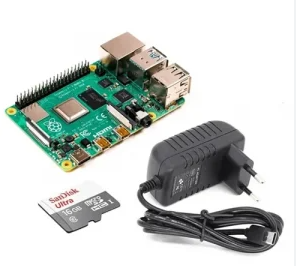
• Raspberry Pi board (choose the appropriate model for your project)
• Micro SD card (8GB or higher, for storing the operating system and data)
• Power supply (micro USB)
• HDMI cable and compatible monitor/TV
• USB keyboard and mouse
• Internet connection (via Wi-Fi or Ethernet)
2) Set Up the Operating System
To start, you need to install an operating system (OS) on your Raspberry
Pi. The most popular choice is Raspberry Pi OS (formerly known as Raspbian).
Here's how:
• Download the Raspberry Pi OS image from the official website.
• Use a tool like Etcher to write the image onto your micro SD card.
• Insert the micro SD card into the Raspberry Pi.
3) Connect Peripherals and Power
Connect your Raspberry Pi to the peripherals:
• Attach an HDMI cable between your Raspberry Pi and the monitor/TV.
• Connect the USB keyboard and mouse to the available USB ports.
• Plug in the power supply to the micro USB port on the Raspberry Pi.
4) Initial Boot and Setup
When you power on the Raspberry Pi, you'll be greeted by the initial
setup process:
• Select your preferred language and location.
• Set a new password for the default user ("pi").
• Connect to Wi-Fi (if using wireless) or set up a wired Ethernet connection.
• Update the software packages to ensure you have the latest versions.
5) Exploring the Desktop
Once you've completed the initial setup, you'll land on the Raspberry
Pi OS desktop. This environment will look familiar to anyone
who has used a computer before:
• Click on the Raspberry logo in the upper-left corner to access the
main menu.
• Browse the installed applications, including a web browser, text editor, terminal, and more.
• Use the web browser to explore the internet, and the terminal to
enter commands.
6) Installing Software
You can install new software on your Raspberry Pi using the built-in
package manager:
• Open the terminal.
• Use the command sudo apt-get update to update the package list.
• Use sudo apt-get install
(replace
7) GPIO (General Purpose Input/Output)
Raspberry Pi's GPIO pins allow you to interface with the physical world:
• Research the GPIO pinout for your Raspberry Pi model.
• Use Python or other programming languages to control GPIO pins
and interact with sensors, LEDs, and more.
8) Exploring Projects
Now that you've got the hang of the basics, it's time to explore various
projects based on your interests. Some popular project ideas include:
· Setting up a media center with Kodi.
· Creating a retro gaming console with RetroPie.
· Building a home automation system.
· Developing IoT projects using sensors and actuators.
· Experimenting with robotics and AI.

Ⅵ. Conclusion
The Raspberry Pi is a remarkable testament to the power of compact
computing. From its modest origins, it has grown into a cornerstone
of the maker an technology communities. Its versatility, affordability
, and potential for innovation have led to a wide array of applications
, from educational initiatives to industrial solutions. By understanding
its components and capabilities, enthusiasts and professionals can
unlock the full potential of the Raspberry Pi and embark on exciting
technical journeys limited only by their imagination.
Many people are giving up their desktop computers because they take
up space and increase their electricity bills. Laptops sound like a viable
option, but they're expensive. If only there was a happy compromise
between these extremes.
That would be the minicomputer. It's the perfect compromise between a
laptop and a desktop computer, offering the ergonomic freedom of a
desktop computer while being smaller, cheaper and more energy efficient
than a laptop. If you had to choose, which one would it be?


Related Articles

Transceiver explained:Types, Working, Applications
Various Types of Diodes: A Comprehensive Classification
Single-Phase vs. Two-Phase Liquid Immersion Cooling:Which is Better
How to Add DS1307, DS3231, PCF8563 RTC with Arduino: Tutorial
What Is a Throttle Position Sensor (TPS) And How It Works
Exploring the Power of X Elite
Machine SCADA Expert: Transforming the Development of Electronic Components and Technology
Harnessing Electric Electromobiles to Combat Global Warming and Pollution
Foldable Phone Comparison: Top 4 Folding Phones
Wireless Keyboards: The Evolution of a Technological Marvel
What are PCBs, How do PCBs Work: Types, Applications
Raspberry Pi 5: The Next Generation of Single Board Computers